Research framework
Coupling between Atmospheric Composition and Meteorological Processes in the Boundary Layer
Academic positioning: Interactions between Atmospheric Chemical and Meteorological Processes
Overview
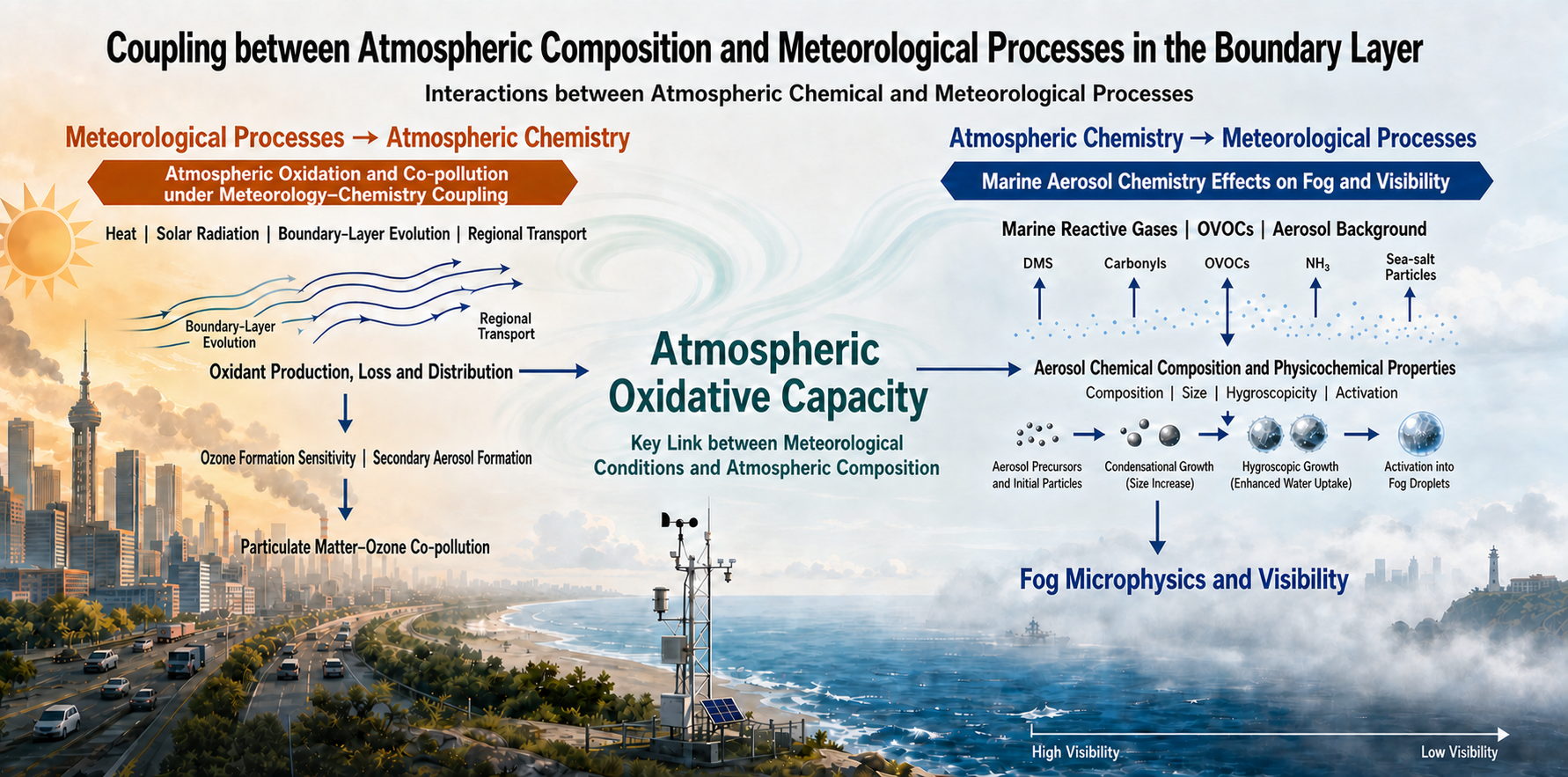
Meteorological processes alter the accumulation, transport, and chemical transformation of atmospheric constituents. Conversely, the chemical composition and physicochemical properties of aerosols can affect hygroscopic growth and activation, thereby participating in fog processes and visibility changes. My research examines this coupling between atmospheric composition and meteorological processes in the boundary layer.
The research proceeds in two directions: how meteorology influences atmospheric chemistry, and how atmospheric chemistry participates in meteorological processes. These directions are not presented as one established causal chain; together, they address how atmospheric composition and meteorological states interact within the boundary layer.
Scientific focus
Atmospheric Oxidative Capacity in Meteorology–Chemistry Coupling
Atmospheric oxidative capacity describes the atmosphere's ability to transform and remove trace gases through chemical reactions. It is a key link between meteorological conditions and atmospheric composition.
Radiation, temperature, water vapour, boundary-layer structure, and regional transport jointly affect the production, loss, and distribution of oxidants. Changes in oxidative capacity then regulate pollutant lifetimes and ozone production and, through secondary particle formation and aging, alter aerosol composition, hygroscopicity, and activation potential, thereby potentially contributing to marine cloud–fog microphysics and visibility evolution.
Research direction 01
Atmospheric Oxidation and Co-pollution under Meteorology–Chemistry Coupling
Meteorological processes → Atmospheric chemistry
How do different meteorological states alter atmospheric oxidative capacity and reshape the formation and mitigation response of PM–ozone co-pollution?
Starting from precursor and emission characteristics, this direction integrates local photochemistry, boundary-layer evolution, and regional transport to identify dynamic changes in the oxidation environment, ozone production sensitivity, and co-pollution responses under high-temperature conditions.
- Meteorological driversHeat, radiation, water vapour, boundary-layer evolution, and transport
- Mechanism diagnosisRadical cycling, oxidant budgets, and local–regional interactions
- Pollution responsesOzone sensitivity, secondary particles, and coordinated-control thresholds
Representative research foundations
From emission characteristics and oxidation chemistry to weather-dependent pollution responses

Extreme heat and regional ozone pollution
Examining how high temperatures, stagnant conditions, electricity demand, and emission changes jointly intensified ozone pollution during the record-breaking 2022 heatwave in eastern China.

Changing urban precursors and ozone production
Using detailed chemical mechanisms to quantify how volatile chemical products affect radical cycling, peak ozone, and chemical control regimes.

Observation-constrained oxidation chemistry
Diagnosing radical sources, OH reactivity, ozone budgets, and limiting factors in an oilfield region with an observation-constrained box model.

Emission fingerprints and precursor constraints
Using direct VOC observations and source-profile comparisons in Chinese oilfields to constrain the precursor basis of regional oxidation and ozone formation.
Research direction 02
Effects of Marine Aerosol Chemistry on Fog Processes and Visibility
Atmospheric chemistry → Meteorological processes
How do the chemical composition and physicochemical properties of marine aerosols participate in fog microphysics and visibility changes, and how should models represent these effects?
This direction examines marine reactive gases, oxygenated organics, and the aerosol chemical environment. It seeks to identify how aerosol composition, size, hygroscopicity, and activation affect droplet formation, extinction, and low visibility, and to introduce the key chemical processes into marine-fog simulation and prediction.
- Marine chemical environmentReactive gases, OVOCs, sea salt, and oxidation conditions
- Key aerosol propertiesComposition, size, hygroscopicity, and activation potential
- Fog responsesDroplet activation, extinction, visibility, and model biases
Research foundation and emerging questions
From marine oxidation chemistry to aerosol–fog interactions

Ship emissions and marine atmospheric oxidation
Combining East China Sea cruise observations with GEOS-Chem to quantify ship-emitted HONO and its influence on OH production and the oxidation environment over shipping lanes.
Coastal OVOCs and aerosol formation
Investigating sources of carbonyls and other reactive marine gases, their oxidation environment, and potential contributions to secondary aerosol.
Aerosol chemistry in marine-fog models
Testing how chemical composition and hygroscopic activation affect fog visibility and model biases, and improving process representations.
Low-temperature Arctic marine environments
Using Arctic OVOC samples to explore oxidation conditions under low temperature and low NOx, and their links to aerosol properties.
Shared methodology
From observed phenomena to mechanism identification and model representation
Methods serve both research directions and connect phenomenon detection, interaction diagnosis, mechanism testing, and prediction improvement.
Field observations
Urban, mountain, coastal, research-cruise, and polar samples
Chemical diagnosis
Oxidative capacity, source attribution, sensitivity, and process budgets
Numerical models
Box, chemical-transport, and meteorology–chemistry coupled models
Multi-source data
Surface observations, satellite retrievals, reanalysis, and trajectories
Data methods
Interpretable machine learning, dynamic thresholds, and forecast correction